Introduction
If you are weighing guest posting vs niche edits, you are usually not asking which tactic is cleverer. You are asking which one will move the right pages, within your timeline, without creating work or risk you will regret later.
Both can earn relevant editorial links, and both can waste budget when bought for the wrong reason or pointed at the wrong page.
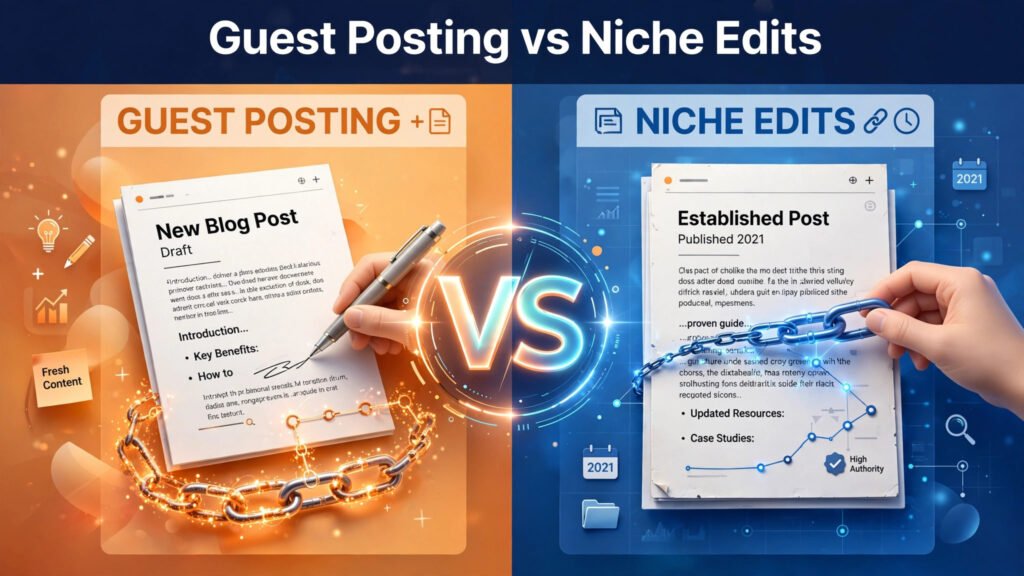
The honest answer is that neither wins in every situation. Guest posting gives you new content and full control over context. Niche edits place your link inside content that already exists, which can be faster and better aligned with a page that is already ranking.
Quick Verdict
Guest posting is usually better when you need new topical content, control over the message, and a link in context built around your target page. Niche edits are usually better when a relevant page already ranks and you need a contextual link live sooner.
For most growing sites, the strongest plan is using guest posts to build topical depth and niche edits to strengthen important pages.
What Is Guest Posting?
Guest posting means creating a new article for another relevant website, published under a byline or contributor format, containing a contextual link back to your site where it fits naturally.
Because the content is new, you help shape the topic, angle, surrounding copy, and how your link is introduced. That control is the main appeal. A well-placed guest post can target a specific theme, support a new cluster, and read like a genuine contribution.
The trade-off is effort and time. Topics need approval, drafts need writing and editing, and publishers work to their own schedules. For the full service breakdown, see our guest posting page.
What Are Niche Edits?
Niche edits, also called link insertions, place your link inside an article already published on another website.
Instead of writing a new post, you find a page where a mention of your resource, guide, or service is genuinely relevant, and a short passage may be adjusted so the link sits naturally in context.
The appeal is fit and efficiency. If the host page is already indexed and ranking for related queries, your link inherits that context rather than starting from a blank page.
The trade-off is control: you do not own the article and cannot rewrite it around your brand. Our niche edits page explains how we source them, and our explainer on what is a niche edit covers the process in detail.
Guest Posting vs Niche Edits: Head-to-Head Comparison
The table below keeps the comparison balanced. Each row reflects a general pattern, not a guarantee, because publisher quality matters more than the tactic’s label.
| Factor | Guest Posting | Niche Edits |
|---|---|---|
| How it works | A new article is written and published on a relevant site, with your link in context | Your link is inserted into a relevant article that already exists |
| Content control | High. You shape topic, structure, and wording around the link | Low to moderate. The original article stays largely as it is |
| Speed to live link | Typically slower, because pitching, writing, and editing take time | Often faster, because only the insertion is needed |
| Typical cost drivers | Publisher fees, writing and editing time, topic complexity, site authority and traffic | Page authority and traffic, ranking position, placement position, publisher fees |
| Indexation certainty | A new page still needs to be crawled and indexed | The page is typically already indexed, though the update needs recrawling |
| Anchor control | Higher. The surrounding sentence is written with your target in mind | Moderate. Anchor must fit the existing sentence naturally |
| Risk profile | Low-quality publisher networks, over-optimized anchors, irrelevant sites | Irrelevant pages, forced insertions, sites selling edits on any topic |
| Scalability | Scales with outreach and writers, but each placement takes production work | Scales when relevant inventory exists, but good pages are finite in any niche |
| Best use cases | New topical clusters, thought leadership, brand-led content, new pages | Strengthening money pages, supporting existing content, ranking pages |
Two points stand out. First, control and speed pull in opposite directions: a new article gives you exact context, while an edit avoids a production cycle. Second, neither tactic is inherently safer.
A guest post on a site built only to sell posts is a poor link, and so is an insertion on an irrelevant page.
When to Choose Guest Posting
Choose guest posting when the content itself is part of the value.
You need new topical coverage
If there is no good existing page on a topic in your niche, an insertion is not an option. A guest post lets you create that coverage and build topical authority over time with related placements.
You need brand voice and message control
Launches, original research, expert commentary, and opinion-led pieces all need control over wording. A guest post lets your point of view appear in full, rather than as a single line in someone else’s article.
You are building toward digital PR
Guest posting sits closer to digital PR than link insertions do. A strong contributed article can start relationships with editors and support brand visibility. If relationships matter alongside the link, the extra effort is often justified.
You are supporting a new page or cluster
New service pages and blog clusters often need links in precisely written context. A guest post can be planned around that exact theme, so the referring page and target page reinforce each other.
When to Choose Niche Edits
Choose niche edits when a strong page already exists and you need support efficiently.
A relevant page already ranks
If a publisher already has an indexed, ranking article that covers your topic well, inserting a genuinely helpful link into it can be more natural than publishing yet another similar article elsewhere.
You need speed without a production cycle
Edits often go live faster because there is no full draft to write and approve. That can matter for a fixed reporting period, a page close to ranking well, or a test where you want to observe impact sooner. Faster does not mean rushed, though.
Vetting still matters.
You are supporting existing content
Niche edits work well as support links. A money page, comparison guide, or key blog post that already performs can benefit from relevant references pointing into it, especially from pages on closely related subtopics.
Your content assets are limited
Not every business has writers on standby. If your asset is a strong target page rather than a library of contributed articles, edits let you build links without first building a production line.
Using Both in One Campaign
For many sites, guest posting vs niche edits is a false choice. The tactics solve different problems, and a balanced campaign uses each where it is strongest.
A common pattern works like this. Guest posts build new topical clusters: contributed articles on related themes, each linking naturally to a hub page, guide, or service page you are developing.
In parallel, niche edits strengthen the pages that matter most commercially. You find existing ranking articles in your niche and add contextual links into money pages and your best supporting content.
Agencies running this mix for multiple clients often standardize it through white label link building, so quality checks and anchor distribution stay consistent. Review anchor text across both tactics as a whole.
The most common failure is not the mix itself, but using the same exact-match anchor repeatedly across both, which looks unnatural.
Budget the mix by goal, not habit. Topical depth means weighting guest posts more. Supporting key pages quickly means weighting edits more. Review results by target page, not links delivered.
Common Mistakes With Each Tactic
Mistakes with guest posting
The biggest mistake is buying volume on sites that accept everything. A site that publishes unrelated topics, has no editorial standard, and links out to anyone is not building your authority, whatever its metrics claim.
Other errors include thin content written just to house a link, the same anchor in every post, and irrelevant topics chosen because the site was easy to secure.
Mistakes with niche edits
The equivalent mistake is inserting links into any ranking page, relevant or not. A topically distant page with good traffic is still a poor placement if your link does not help its readers.
Forced anchors are another problem. If a sentence has to be bent out of shape to fit your link, the placement is wrong. Also check whether the article already carries many sold links.
With both tactics, paid placements should follow search engine guidelines on link spam. Google’s documentation states that buying or selling links intended to manipulate rankings can violate its policies, which is why relevance and natural presentation matter. See Google’s spam policies for the official wording.
A note on pricing mistakes
Comparing tactics on headline price alone misleads. A cheaper placement that is irrelevant or on a low-quality site is not cheaper in any useful sense.
Compare cost drivers instead, such as publisher quality, traffic, and relevance, and use a transparent pricing structure to judge value by quality, not count. Our breakdown of how much guest posts cost explains the pricing factors in detail.
Decision Checklist
Run through these questions before you commit budget:
- Does a relevant, quality page already exist where my link would help readers? If yes, a niche edit is a strong candidate.
- Do I need the surrounding content written around my exact topic? If yes, choose guest posting.
- How important is speed? If the placement needs to be live soon and a good page exists, lean toward an edit.
- Am I building a new topical cluster or supporting an existing page? New cluster points to guest posts, existing page support to edits.
- What assets do I have? Writers and ideas favor guest posting. Strong target pages favor edits.
- Have I checked the host site for relevance, real traffic, and editorial standards? If not, pause either tactic until you have.
- Does my anchor plan look natural across the whole campaign? If not, fix it before buying anything.
If your answers split, a mixed campaign is usually right.
Conclusion
The guest posting vs niche edits debate resolves once you match the tactic to the job. Guest posting gives you new content, control, and topical depth at the cost of time and production effort.
Niche edits give you speed and the relevance of established pages at the cost of control. Neither is universally better, and neither excuses low-quality placements. Choose by goal, timeline, and assets, and judge every placement by relevance first.
FAQs
1. Are niche edits safer than guest posts?
Neither is inherently safer. Risk depends on site quality, relevance, and how natural the link looks. A relevant edit on a well-maintained page and a quality guest post on a real publication are both reasonable.
2. Which is faster, guest posting or niche edits?
Niche edits are often faster because the host article already exists, so only vetting and insertion are needed. Guest posts typically take longer because they involve pitching, writing, and review. Timelines vary by publisher in both cases.
3. Which gives better anchor text control?
Guest posting usually gives more control because the surrounding content is written for the placement. With niche edits, the anchor has to fit an existing sentence, which limits options but can look more natural.
4. Can I use guest posts and niche edits in the same campaign?
Yes, and many campaigns do. Use guest posts to build new topical clusters and niche edits to strengthen existing money pages and key guides. Manage anchor text across the combined campaign, not tactic by tactic.
5. Do niche edits pass the same value as guest post links?
A link’s value depends more on the linking page’s relevance, authority, and traffic than on how it was placed.
A link on a strong, relevant, ranking page can be highly valuable, while a link in a new guest post on a weak site may pass little. Judge the page, not the format.
6. How do I choose between them for a brand-new site?
A new site often starts with guest posting to build topical relevance, brand presence, and relationships. As its key pages gain traction, niche edits become more useful for strengthening them. The right mix usually shifts over time.