Introduction
If you sell SEO, clients expect links. Building them in-house takes prospectors, outreach staff, writers, and publisher relationships built over months, capacity most agencies do not have.
That is why white label link building exists: you sell the service under your brand, a specialist partner does the outreach and placement work behind the scenes, and your client sees only your agency’s name on the report.
Done well, white label link building is not a shortcut. It is an operating model. It lets a small team offer a full service from day one, lets a larger agency absorb overflow without hiring, and protects your margin because you set the client price.
This page explains how it works, what is included, what it costs, and how to choose a partner you can put your name on.
Key Takeaways
- A third-party provider builds links for your clients, while all reports stay under your agency’s brand.
- The core services are guest posts, niche edits, digital PR, and the content writing that supports them.
- You control the client relationship and the retail price. The provider controls prospecting, outreach, and placement.
- Safety comes from editorial links on relevant sites with real traffic, not volume, private networks, or guarantees.
- A good report is unbranded and client-ready, with the live URL, authority metric, traffic, anchor text, and target page for every placement.
What Is White Label Link Building?
White label link building is a service model where a specialist provider acquires backlinks for your clients on your behalf, and you deliver the work under your own agency’s brand.
The provider is invisible to the client: reports carry your logo, your name, and your voice, not the provider’s.
The chain has four parties. The end client pays for SEO and expects progress. Your agency owns the strategy, the client relationship, and the final report.
The white label provider does the prospecting, outreach, writing, and placement. The publisher, the site owner or editor, agrees to publish the content or add the link. Your client contracts with you, and you contract with the provider.
The same model is also called white label backlinks, a link building reseller program, or outsourced link building. The test is the same: can you resell the deliverable as your own, without the client needing to know a third party was involved?
That invisibility matters, if a report arrives on another company’s letterhead, you look like a middleman, not the expert they hired. Our guide to what is white label link building explains the model step by step, with an example order.
White Label vs Regular Outsourcing
With regular outsourcing, everyone knows. You might share the specialist firm’s reports or introduce them on a call. That can suit some relationships, but it weakens your position: a client who knows your supplier can question your markup, or go direct.
With a white label arrangement, the provider is a silent extension of your team. Drafts, spreadsheets, and reports carry no provider branding. You review everything, add your commentary, and present it as your agency’s work, because strategically, it is.
You set the brief, approved the anchors, and stand behind the result.
How White Label Link Building Works
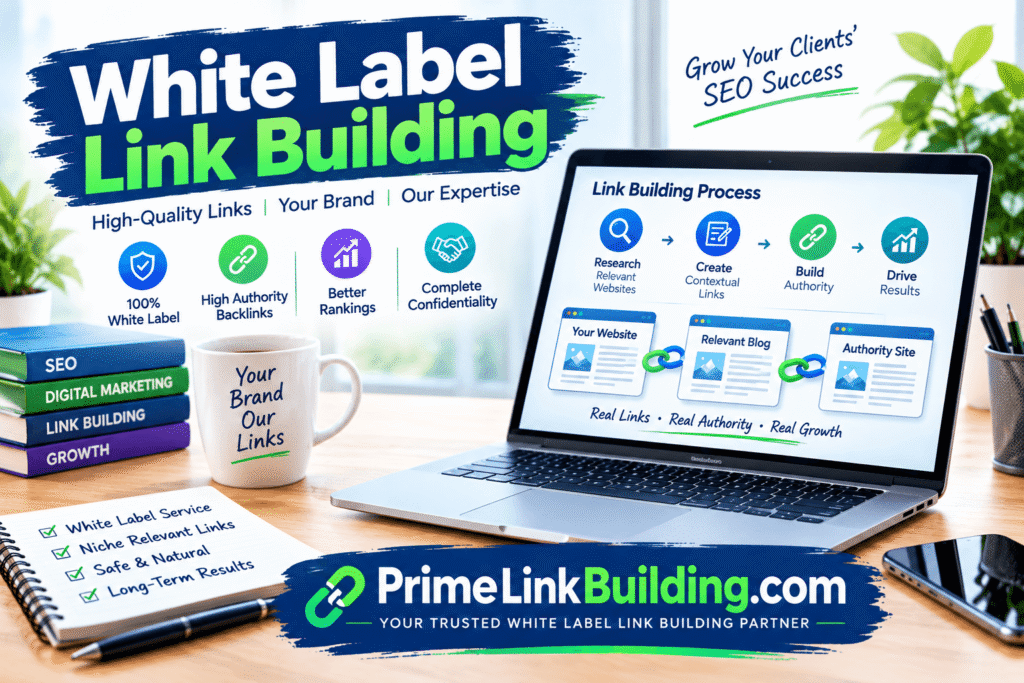
The process follows five steps, and you should be able to see where your order sits at any point.
1. Brief & targets. You share the client’s website, target pages, preferred anchor mix, niches to prioritise or avoid, and any sites the client will not accept.
A good provider pushes back if the brief is unrealistic, for example, if every anchor is an exact-match money keyword.
2. Prospecting & publisher vetting. The provider builds a prospect list from existing relationships and fresh research, checking each site for niche relevance, real organic traffic, a natural link profile, and editorial standards. Sites that exist only to sell links are screened out.
3. Outreach & content production. Specialists pitch editors with a genuine reason to publish, a useful article idea, original data, or expert commentary. Writers produce content to the publisher’s guidelines. For an insertion, the provider proposes the exact sentence so the link reads naturally.
4. Placement & quality check. Once live, each placement is checked: is the link present and correctly pointed, is the anchor as agreed, is the page indexable? Failures should be fixed or replaced before they reach your report.
5. Unbranded reporting. You receive a clean report with no provider name or logo. You add your branding and strategic notes, then send it to the client in your normal reporting.
You remain the strategist throughout. For the wider picture, start with our link building services.
How Long Does It Take?
First placements typically appear within a few weeks of an approved brief, because prospecting and outreach must happen first. A guest post can move faster if a publisher has a slot open; digital PR can take longer because it depends on a journalist’s schedule.
Ranking movement generally takes longer. Links must be crawled, indexed, and weighed alongside content quality, internal linking, technical health, and competition. Anyone promising a specific position, or results by a date, is promising something no provider controls. Judge a partner on placement quality and consistency.
White Label Link Building Services Included
When agencies buy white label link building, they are rarely buying one tactic. They are buying a menu of placement types, chosen per client by budget and niche.
Guest Posts
Guest posting means writing a useful article for a relevant third-party website, with a natural link back to your client’s site inside it. It is the workhorse of most campaigns because it creates a new, indexable page built around your client’s topic.
Best for clients who need topical authority, links to specific pages, and fresh referring domains. The deliverable is a published article on a vetted site, with an agreed anchor and target URL. See editorial guest posting for the tactic in detail.
Niche Edits (Link Insertions)
A niche edit places your client’s link into an article already published, indexed, and often already ranking. The provider negotiates with the site owner to add a relevant sentence or expand a paragraph so the link earns its place.
Best for links into older, established content in a tight niche, without waiting for new content. The deliverable is the live URL of the updated page, showing the link in context. Read more about niche edits (link insertions).
Digital PR & Journalist Outreach
Digital PR earns links by giving journalists something worth citing: original data, a survey, expert commentary, or a story with a news angle. Placements can land on larger publications guest posts rarely reach, so one campaign can outperform a month of standard outreach.
Best for clients with a story, data, or a recognisable brand. The deliverable is live coverage with a link, reported with the publication, URL, and anchor. Our service page explains digital PR and journalist outreach in full.
Content Writing
None of this works without writing an editor will accept. Content writing here means the guest articles, expert quotes, and data summaries produced to earn the placement, written to the publisher’s guidelines, not spun or templated.
It matters for every client, especially in regulated or technical niches where accuracy decides acceptance. The deliverable is the published content, plus the draft for your approval on request.
Who Uses White Label Link Building?
Most agencies that sell SEO without a full outreach team use white label link building in some form. Two groups rely on it most.
SEO Agencies
Link building is lumpy work: one month a new client needs many placements, the next several clients renew at once. Hiring for peak demand leaves you overstaffed in quiet months, and training an outreach specialist takes longer than most contracts allow.
A partner smooths that out. The agency keeps strategy, account management, and reporting in-house, the parts clients value, and flexes placement work up or down.
It also brings coverage in niches where the agency has no publisher relationships, such as legal, finance, home services, or healthcare.
Freelancers & Small Agencies
This segment benefits most, and providers talk about it least. A freelancer or three-person agency cannot justify a full-time outreach hire, cannot spend twenty hours a week pitching, and often cannot get replies from editors who do not recognise their name.
Without links, though, their retainers stall, and clients leave for an agency that delivers the full service.
White label supply solves that. A small agency can offer the same placement types as a larger competitor, price the service into existing retainers, and spend its limited hours on strategy, content, and client relationships, where a small team has a real edge.
Start small: one client, one placement type, one report cycle. Judge the partner on that order first.
White Label Link Building Pricing, and Your Margin
Your profit lives in the gap between the wholesale price you pay and the retail price your client pays, so demand transparency here.
Across provider pricing pages checked for this guide, per-link prices ranged from roughly $50 for low-tier placements to $1,500+ for premium editorial links; fully managed retainers commonly run $1,000–$5,000+ per month.
Those are market ranges, not a quote. Price moves with the site’s authority and traffic, the niche, whether writing is included, and whether the placement is a standard guest post or a hard-won editorial or PR link.
A cheap link is not automatically bad, and an expensive one is not automatically good, sample placements matter more than a price list. For a fuller breakdown of the models behind the ranges, see our guide to how much link building costs.
Providers usually sell per link, in monthly packages, or as a managed retainer. Before you commit, see white label pricing and compare it with what you charge clients for the same deliverable.
A Worked Margin Example
The following is an illustrative example only, using round numbers, not a price list and not a promise of profit.
Suppose the wholesale cost is $150 for one guest post placement. You charge the client $300 for it inside your SEO package. Your gross margin is $150, before your time and overheads.
Across ten placements a month: wholesale cost $1,500, client price $3,000, gross margin $1,500.
Your real profit depends on time spent briefing, reviewing, and reporting, which is why a client-ready report has financial value. Every hour not spent reformatting a supplier’s spreadsheet is margin you keep.
White Label vs In-House Link Building
Neither model is universally better. It depends on your volume and hiring ability.
| Factor | White Label | In-House |
|---|---|---|
| Time to first link | Weeks, using an existing publisher network | Months, while hiring, training, and building relationships |
| Cost structure | Variable, per link or per month, no salaries | Fixed salaries, tools, and management overhead |
| Scalability | Scale up or down with client demand | Limited by team size and outreach capacity |
| Control | You set the brief and approve placements; provider runs outreach | Full control over every pitch, draft, and relationship |
| Risk | Quality depends on vetting your partner carefully | Quality risk stays internal, but so does the cost of mistakes |
Is White Label Link Building Safe?
It is safe when links are earned editorially and would still make sense if nobody looked at a ranking chart. It is unsafe when the model hides low-quality tactics behind your brand, because your name is on the report.
White-hat practice means:
- Manual outreach to real websites with real audiences and editorial control.
- Relevant placements, where the linking and target pages are genuinely related.
- Content written for the publisher’s readers first, with the link as a natural citation.
- A varied anchor mix, brand, URL, and topical phrases, not repeated exact-match keywords.
- Sites with organic traffic, not profiles built by selling placements to everyone.
- Full transparency to you: live URLs you can inspect before the client sees them.
Google’s position should shape every decision. Under Google’s link spam policy, buying or selling links for ranking purposes is link spam, unless the link is properly qualified with rel=”sponsored” or rel=”nofollow”.
Paid placements that pass ranking value without that qualification violate the policy, and Google can ignore the links or take manual action.
That is why editorial placement matters: a link an editor chose because the content deserved it is different from one inserted purely because money changed hands.
No provider can guarantee rankings, and safety is never absolute. What you control is the standard of site, content, and anchor you accept, and refusing placements that miss it.
Red Flags: Providers to Avoid
- PBNs. Private blog networks are sites controlled to manufacture links. If a provider will not show the sites, assume this is why.
- Guaranteed rankings. Nobody controls Google’s results. A guarantee is a sales tactic, not a feature.
- No sample placements. A legitimate provider can show live examples in a comparable niche before you pay.
- No live URLs. Reports built on screenshots or domain lists hide everything that matters.
- Instant volume at implausible prices. Hundreds of links in days, far below market ranges, usually means automation or networks.
- No replacement policy. Links get removed. Without a stated policy, that cost lands on you.
How to Choose a White Label Link Building Partner
Choosing a partner is a vetting exercise, not a shopping exercise. You are handing someone part of your client’s reputation.
Green flags
- Sample placements you can open and verify are still live.
- Clear publisher vetting criteria: relevance, traffic, and editorial standards.
- Approval before placement, or a clear way to exclude niches and site types.
- A stated replacement approach if a live link is removed.
- Unbranded reports that arrive on time and are complete enough to forward.
- Straight answers about tactics, including what they will not do.
Red flags
- Vague talk of “authority sites” and “our network” with nothing you can check.
- Pressure to buy a large package before a single test order.
- No named deliverables, no timelines given as ranges.
- Reports that lead with one authority score and hide the URLs.
Ask what every placement report includes. At minimum: the live URL, a recognised authority metric such as DR, the site’s organic traffic, the exact anchor text, and the target page. If any of those five is missing, you cannot review the work properly.
Start with a paid test on one client, and only then build the service into your packages.
What a White Label Report Includes
The report is the product your client actually sees. A proper one is an unbranded document, no provider logo, name, or branding in the file or its metadata, ready for your logo and commentary.
For each placement it lists the live URL, the linking domain’s authority metric, estimated organic traffic, the anchor text, and the target URL.
A short note on placement type, guest post, niche edit, or digital PR coverage, helps the client understand it without an SEO lesson.
A good report also separates delivered placements from work in progress, and does not pad itself with vanity charts or ranking claims the links alone did not cause.
Check it before you forward it, then add your own interpretation of what this month’s links mean for the client’s strategy.
Conclusion + CTA
Agencies do not lose clients because they used a partner. They lose clients because they promised links they could not build, or delivered links they could not defend.
White label link building, run with a vetted partner and honest reporting, removes both risks: you offer a complete service, inspect every placement, and keep the client relationship and the margin. Start with a single test order and judge the live URLs yourself.
Ready to sell link building under your own brand? Talk to Prime Link Building about a test placement for one client, review the unbranded report, and decide whether to build it into your retainers.
Frequently Asked Questions
1. What is white label link building?
A specialist provider builds backlinks for your clients, and you deliver the work under your agency’s brand. The provider handles prospecting, outreach, content, and placement. Your client sees only your name on the report.
2. Will my client know I used a provider?
No, if the arrangement is genuinely white labelled. Reports and deliverables carry your branding only, and you review everything first. The only way a client finds out is if you choose to tell them.
3. How much does it cost?
Across provider pricing pages checked for this guide, per-link prices ranged from roughly $50 for low-tier placements to $1,500+ for premium editorial links, and fully managed retainers commonly run $1,000–$5,000+ per month. Your cost depends on the site, the niche, and whether writing is included.
4. What margin can agencies make?
It depends on the retail price you set, because you control it. In the illustrative example above, a $150 wholesale placement charged at $300 leaves a $150 gross margin before your time and overheads.
5. Is it safe for my clients’ websites?
Yes, when placements are editorial, relevant, and on real sites with traffic. It is unsafe when they come from private networks or automated schemes. Google treats buying or selling links for ranking purposes as link spam unless they are qualified with rel=”sponsored” or rel=”nofollow”.
Vet your provider and inspect every live URL.
6. How fast are results?
First placements typically appear within a few weeks of an approved brief, depending on the tactic. Ranking movement generally takes longer, because links must be crawled and weighed alongside the rest of the site. No provider can guarantee a position or a date.